
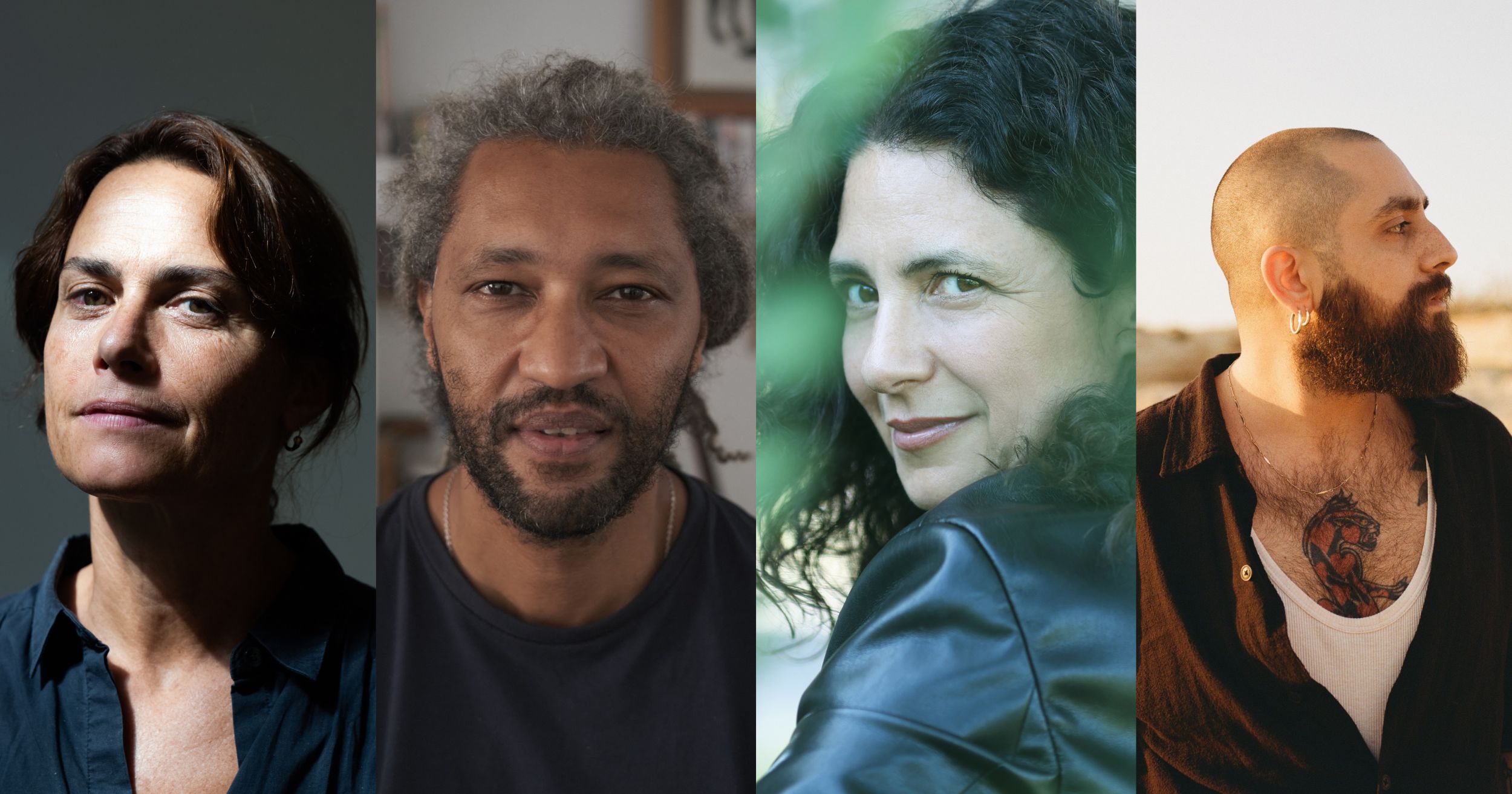
Memories for the future. How sources construct individual and collective narratives in cinema. Mohamad Abdouni, Alain Gomis, Costanza Quatriglio in conversation with Alina Marazzi. A screening programme and masterclass at Sala Laguna
Among the highlights of the 2026 edition of Isola Edipo is the return of Cinema of Inclusion – Between Vision and Education. Organized in collaboration with the Giornate degli Autori and the Fondation Cartier pour l’art contemporain, which has been a partner of this initiative for the past five years, it is dedicated to exploring the relationship between cinema and the contemporary world. This year’s edition is titled:
“MEMORIES FOR THE FUTURE – How Sources Construct Individual and Collective Narratives in Cinema.”
The programme will bring together Lebanese artist and director Mohamad Abdouni, French-Senegalese director Alain Gomis, and Italian director Costanza Quatriglio, in conversation with Italian director Alina Marazzi.
This year’s conversation explores cinema as a language capable of writing and rewriting both individual and collective histories and identities. Particular attention will be devoted to the role of sources—including archival materials, official historical records and oral testimonies, the power of cinema to bring erased stories back into public consciousness, and the dynamic relationship between personal experience and collective memory in the construction of narrative.
In an era increasingly defined by a culture of “post-truth” and relentless presentism, the discussion will examine the possibilities, functions, and responsibilities of cinema in shaping personal, familial, and communal portraits, highlighting the fundamental role that memory plays in this process.
Cinema of Inclusion between Vision and Education thus returns this year as a space for dialogue and critical reflection, bringing together some of today’s most significant filmmakers to discuss the relationship between cinema and some of the most pressing and essential issues of our time.
Conceived by Isola Edipo and developed in collaboration with Giornate degli Autori and the Fondation Cartier pour l’art contemporain, the initiative continues to stand at the intersection of artistic vision and educational engagement.
Through screenings, discussions, and multidisciplinary encounters, Cinema of Inclusion aims to reaffirm the central role of art in imagining our shared future through a renewed awareness of the importance of both the stories art preserves and the stories we carry ourselves.
The event will take place on 4 September 2026 at Sala Laguna:
a venue curated by Isola Edipo and Giornate degli Autori, dedicated to screenings and public conversations in the heart of the Venice Film Festival.
The programme will consist of two parts.
Main Event
4 September | 6:00–8:30 pm
A conversation featuring Mohamad Abdouni, Alain Gomis, and Costanza Quatriglio, moderated by Alina Marazzi, interspersed with screenings of excerpts from the participating filmmakers’ works.
Extended Programme: screenings
Over the course of 3 and 4 September 2026, Sala Laguna will also host screenings of the following films:
3 September
11:00 am
Treat Me Like Your Mother — Mohamad Abdouni (2025, Lebanon, 76′)
6:30 pm
Rewind & Play — Alain Gomis (2022, France/Germany, 65′)
4 September
8:30 am
The Secret Drawer (Il Cassetto Segreto) — Costanza Quatriglio (2024, Italy/Switzerland, 132′)
12:00 pm
For One More Hour with You (Un’ora sola ti vorrei) — Alina Marazzi (2002, Italy, 55′)
Reservations
To attend the masterclass on 4 September at 6:00 pm at Sala Laguna, reservations can be made by emailing laguna.edipore@gmail.com starting 24 August.
To attend the screenings on 3 and 4 September at Sala Laguna, reservations can be made by emailing laguna.edipore@gmail.com starting 24 August.
Press Office
Studio Systema – Venezia
Adriana Vianello +39 349 0081276
Andrea de Marchi +39 349 3744356 systema@studiosystema.it
ARTISTS
Mohamad Abdouni is an artist, photographer, and filmmaker based in Beirut, and the Editor-in-Chief and Creative Director of COLD CUTS, a photo journal exploring queer cultures across the SWANA region. His work has been exhibited at institutions including the Brooklyn Museum, FOAM (Amsterdam), FOMU (Antwerp), Lafayette Anticipations (Paris), and the Lyon Biennale. He is the recipient of the 2023 Lafayette Anticipations Prize at Art Basel. His films have been screened at IDFA and BFI, among other international festivals. Alongside his artistic practice, he has directed narrative fashion films and music videos for clients such as Gucci, Vogue, Burberry, Fendi, and The New York Times. His work centers on archival research, image-making, and the politics of representation, particularly in relation to queer histories in the Arab-speaking world. His long-term project Treat Me Like Your Mother: Trans Histories From Beirut’s Forgotten Past* has evolved into a film and live performance currently touring internationally. The archive is held at the Arab Image Foundation. He is currently developing new films and research-based works, including a newly uncovered archival collection that further interrogates authorship, memory, and the ethics of looking.
Franco-Senegalese filmmaker Alain Gomis made his directorial debut in 2002 with L’AFRANCE, a film about the struggles of immigrants in France which won a Silver Leopard award at the Locarno Film Festival. His sophomore film ANDALUCIA was shown at the Venice Film Festival in 2012. TEY (AUJOURD’HUI), his third feature starring Saul Williams, shown in competition at the Berlinale, won a Golden Stalion at Fespaco. He returned to the Berlinale in 2017 with FÉLICITÉ where it won the competition’s Grand Jury Prize, followed by a second Gold Stallion at Fespaco. The film represented Senegal at the Oscars where it was shortlisted for Best Foreign Language Film. In 2022, REWIND & PLAY, his first feature-length documentary, a free archives based archival film on the legendary jazz pianist and composer Thelonious Monk, premiered at the Berlinale (Forum) and won the best middle-length documentary at Toronto’s HotDocs. In 2018, he founded the Yennenga Center in Dakar, Senegal—a sociocultural center and film school dedicated to developing film production and post-production in West Africa—which he has directed ever since. In 2026, DAO, his sixth feature film, premiered in competition at the Berlinale.
Alina Marazzi
Film, documentary and theatre director; film programmer and lecturer. Female subjectivity and images of memory are at the core of her work.
Filmography includes: Un’ora sola ti vorrei, a portrait of her late mother created through family footage; Per Sempre, a documentary on female cloistered life; Vogliamo anche le rose, an archival feature film exploring stories of women and sexual liberation in the 1970s; Tutto parla di te, starring Charlotte Rampling, a feature film about the darker side of motherhood; Confini, an archival short film featuring poetic verses by Mariangela Gualtieri; Anna Piaggi, una visionaria nella moda, a portrait of the fashion journalist; To cut is to think, a portrait of artist Lucia Marcucci commissioned by Maison Dior. For opera, she has collaborated with composer Maestro Mauro Montalbetti on Il Sogno di una cosa and Hayè, le parole la notte, with librettos by Marco Baliani and Alessandro Leogrande respectively. She is co-artistic director of UnArchive Found Footage Fest.
Costanza Quatriglio
Director and writer, she is the Artistic Director of the Palermo branch of the Centro Sperimentale di Cinematografia. After completing her studies in law, she graduated in film directing from the CSC in 1999. She has always worked at the intersection of reality and fiction, through a strong focus on expressive research. Her films have been presented at the Cannes Film Festival, the Venice International Film Festival, the Berlinale, the Locarno Film Festival, and many other international festivals, receiving numerous awards and recognitions. In Italy, she has won four Nastri d’Argento and one Ciak d’Oro. She made her debut with L’isola (Directors’ Fortnight, Cannes 2003). Among her most awarded films are Terramatta; (Giornate degli Autori, 2012); Con il fiato sospeso (Venice Film Festival – Out of Competition, 2013); Triangle (2014); 87 ore (2015); Sembra mio figlio (Locarno Film Festival, 2018); and Il cassetto segreto (Berlinale, 2024, shortlisted among the five finalists for the David di Donatello Awards). For television, in 2007 she was Creative Producer of the series Un posto al sole; in 2021 she directed the TV movie La bambina che non voleva cantare; in 2025 she created the docufiction Il gigante innamorato, presented at the Rome Film Fest; and in 2026 she directed the TV movie Sul cammino di Francesco.
FILMS
Rewind & Play by Alain Gomis
December 1969, Thelonious Monk in Paris. Before the evening concert, he records a television programme for French television.The footage reveals a Thelonious Monk trapped inside the violent machinery of stereotypes, desperately trying to break free from it.The film becomes the story of this great artist’s journey, of a man who wishes to exist solely through his music. At the same time, it paints a negative portrait of a media mechanism that is as ridiculous as it is repulsive. Here is the machine at work. To dismantle these raw materials means to deconstruct them as if they were ghosts, in order to observe how the factory of caricatures operates. A deaf, smiling, ambiguous machine, at once admiring and nauseating. Holding a microphone without listening, marvelling without seeing.An attempt to overturn the point of view. Here is Thelonious going through this ordeal, at work, as if he had landed on an unknown planet where a portrait of him is being constructed over which he has no control. Exhausted by years spent submitting himself to this painful exercise. Fortunately, he plays. And in doing so, he manages to express more than any words could ever say. “I get tears in my eyes when I see all the shit my father had to endure.” — T.S. Monk Jr.
Treat Me Like Your Mother by Mohamad Abdouni
This photographic documentary uncovers the intimate experiences of four trans women from Lebanon, recounting tales spanning from pioneering Lebanese state-funded gender-affirming surgery in 1997 to vanished safe spaces today. Together, Em Abed, Jamal Abdo, Antonella, and Mama Jad present an untold history to the backdrop of what is arguably the first photographic archive of trans women in Lebanon. Treat Me Like Your Mother is a photographic scrapbook, with images from the women’s personal archives, as well as home video footage from photographer and director Mohamad Abdouni’s family vault. He weaves in his own experiences growing up and his exploration of gender as an adult, accompanied by the voices of the four women. They talk about the Raouche strip—a queer haven on the coast of Beirut—remember trans friends, and reflect on lives lived amid war, chaos, and uncertainty. Abdouni’s film explores the social integration of the trans community in Beirut over the past four decades. It stands as a heartfelt tribute to the power of community, friendship, and Motherhood in the face of adversity.
Il Cassetto segreto by Costanza Quatriglio
Sicily, the world, a home, a library. A sentimental and adventurous journey through a now-unknown 20th century, unfolding through 8mm reels, photographs, sound recordings, and documents from a unique archive: that of journalist and writer Giuseppe Quatriglio, who devoted his life to recounting History from the perspective of a universal Sicily inhabited by artists, poets, and intellectuals. The spark for the film is the intense work undertaken by his daughter, filmmaker Costanza Quatriglio, in preparation for the final separation from her father’s library, donated to the Central Library of the Sicilian Region. From the family home, places steeped in stories unfold; private and collective memory intertwine in a dense dialogue between daughter and ninety-year-old father, captured in previously unseen footage filmed between 2010 and 2011 and preserved until today.
Un’ora sola ti vorrei by Alina Marazzi
The film reconstructs the journey undertaken by the director in her personal search for the face of her mother, Liseli, through the editing of old family footage. It is an attempt to bring her back to life, even if only on screen, a way of celebrating her memory. Nostalgia permeates the narrative because it is the feeling necessary to overcome a loss; it is an essential condition for living. “My mother was born in 1938 and died in 1972, when I was seven years old. Telling her story through these old films made by my grandfather meant, for me, restoring dignity to the memory of the person who brought me into the world. It is a gift I want to give to myself, to her, to all children, and to all parents.” — A. Marazzi
